Growers Line Up to Donate Unsold Vineyards to Marsh
 AI illustration
Wine Country — Napa's new estuary park on South Jefferson Street returned 46 acres of former vineyard to tidal marsh with $5.06 million in state grants. Growers with uncontracted cabernet have formed a line at the trailhead holding deeds.
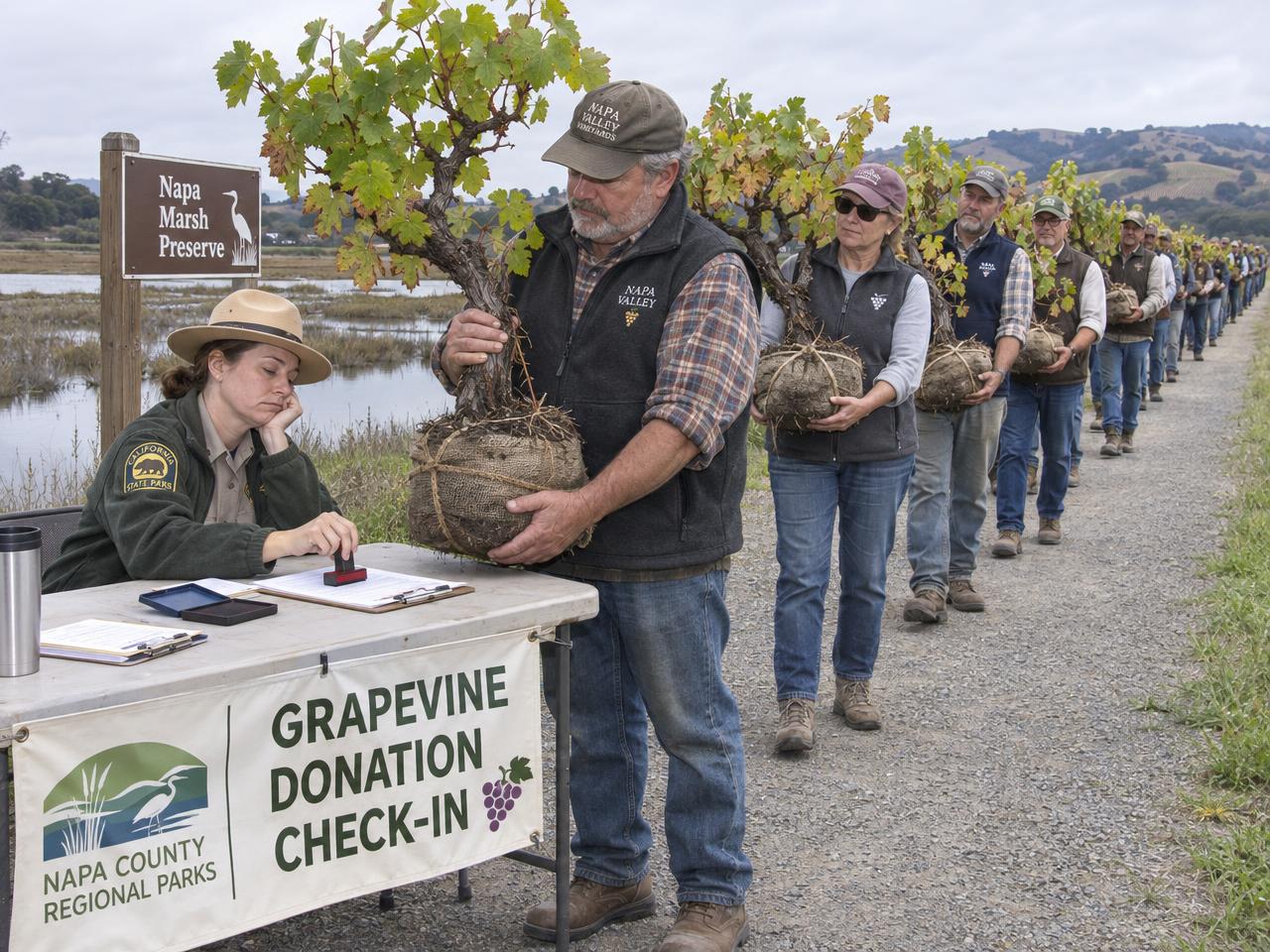
By 7 a.m. Tuesday, a line of pickup trucks stretched from the gravel lot at the south end of South Jefferson Street back past the Highway 29 overpass. The growers in it were not there to hike. They were there to donate. Each carried a folder with a property deed, a tax bill and, in several cases, a sample of cabernet in a Ziploc bag labeled with the block number. Parks staff had set up a folding table beside the interpretive kiosk, where a volunteer handed out intake forms. "We're not taking anything that isn't free and clear," said Dolores Varnell, the district's Intake Coordinator for Restoration Parcels, who has held the title since the park opened. "We're also not taking anything with a lien from the Sonoma bank." By 9 a.m., she had stopped counting people at 60.
The intake form is one page. Question four asks the donor to state the reason for conversion to wetland. Two boxes are provided: No buyer and Buyer deferred. A third box reading "Other" has no line beneath it. Several growers checked both. Ron Kittridge, who farms 11 acres of Carneros fruit north of the Napa County line, filled in the form standing up at the folding table. "Deferred is the nice word," he said. "I want the county to know the difference between deferred and canceled." Varnell said the district does not distinguish between the two. "We're resting the block," she said. "That's what the form is for."
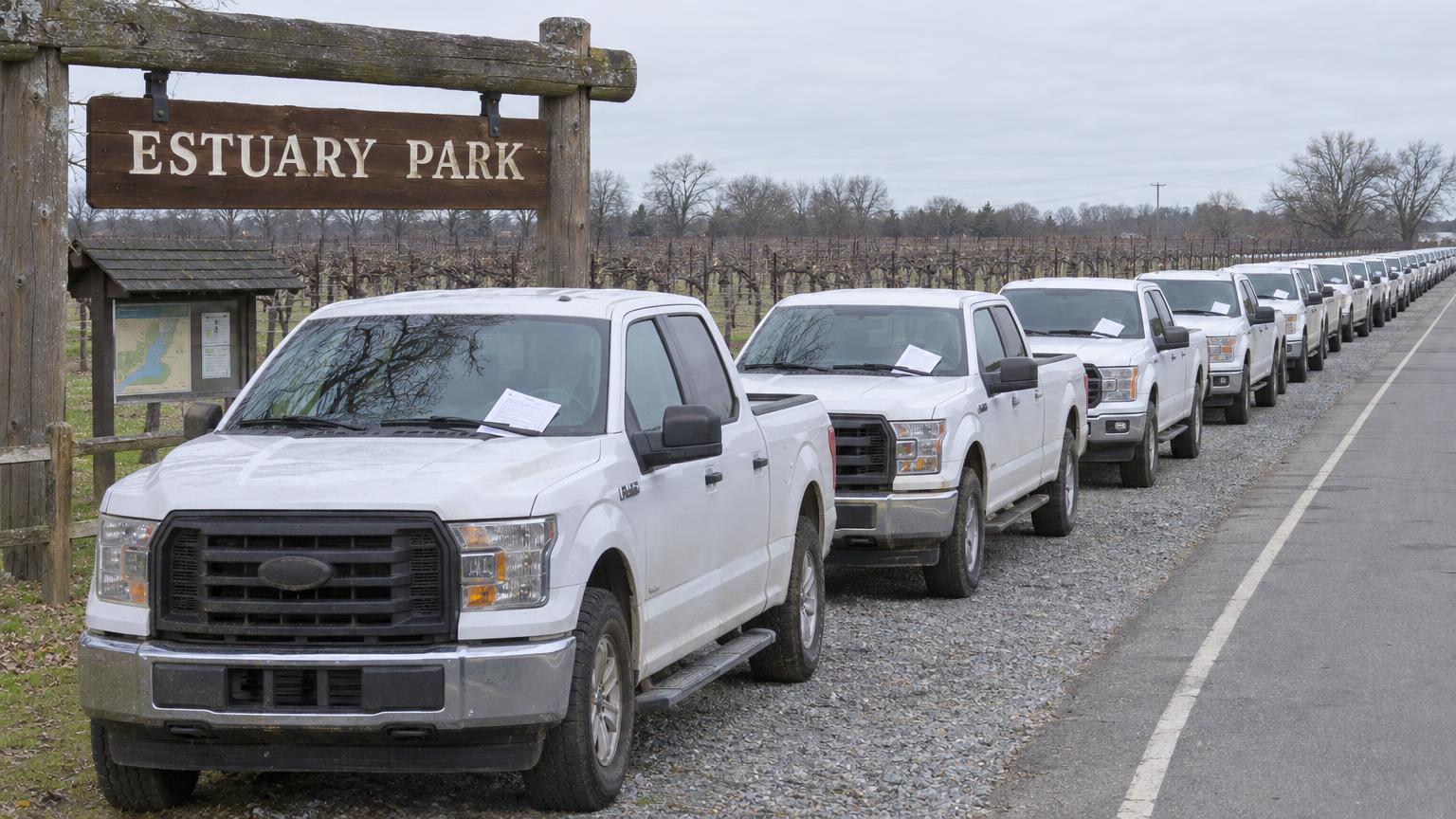
The queue for the trailhead on Tuesday morning, forms in hand.
By the end of the first week, the district had opened a waitlist for the 46 acres. The county's staff memo describing it noted the list was already longer than any allocation list in the valley, a comparison that has previously been reserved for tasting-room reservations at wineries with use permits from 1984. Growers in line were told their names would be called in order of harvest date. Kittridge said he was third from the top, behind a Calistoga family and a man who had brought a laminated map of his block with its soil series printed in the corner. "It's the first time anyone in this valley has been asked for the soil series," said Kittridge. "Usually they just want to know if you'll sell."
A grower from St. Helena asked the staff at the table whether a breached levee counted toward resting the block. The question went to Varnell, who consulted a binder marked RESTORATION CRITERIA and then, after a pause, said the levee was "a tidal influence feature" and would be considered on a parcel-by-parcel basis. The grower wrote this down. He had two parcels, one of which, he said, had flooded in February and has not dried out since. Asked whether he was pleased with the answer, he said he was pleased to have an answer. "Before this, I had a crop nobody wanted and a bank that wanted the land," he said. "Now I have a swamp the state wants, and a park that asks me to fill out four questions." The barn on the eastern parcel may become an interpretive center, according to a draft plan posted at the kiosk.
By Thursday, a commercial broker from Santa Rosa had set up a card table at the Expo's north gate, two blocks from the trailhead, with a sign offering to "facilitate parcel transitions to public-benefit districts." The broker, who declined to give a name for this story, said his firm had identified eleven vineyard parcels in the Carneros AVA that could be flipped to the parks district before the 2027 design phase. The park's design phase begins in 2027. The district's $600,000 design grant from the San Francisco Bay Restoration Authority is already committed. The broker said he saw no conflict. "It's a lot of cabernet nobody wants," he said. "The state is buying the swamp. We're just the people who know where the swamp is."
The park's arrival at the trailhead comes as the rest of the valley's fruit remains unsold. About half of California's 2026 crop had no buyer under contract when picking began, according to industry data, and 47,229 acres were removed statewide in the past year. Napa grapes averaged $6,767.53 a ton in 2025, which means the most expensive farmland in American agriculture now has a better exit as a marsh than as a crop, and the state is paying for the marsh. At the trailhead, Varnell was handed another folder. She opened it, read the deed, and wrote the block number on a sticky note. Then she checked the box marked Buyer deferred. ■
But seriously…
The joke above is built on a real story. Here's the straight version.
Can growers donate unsold vineyards to a state wetland park, and what happens to the land after it floods?Get the straight answer →