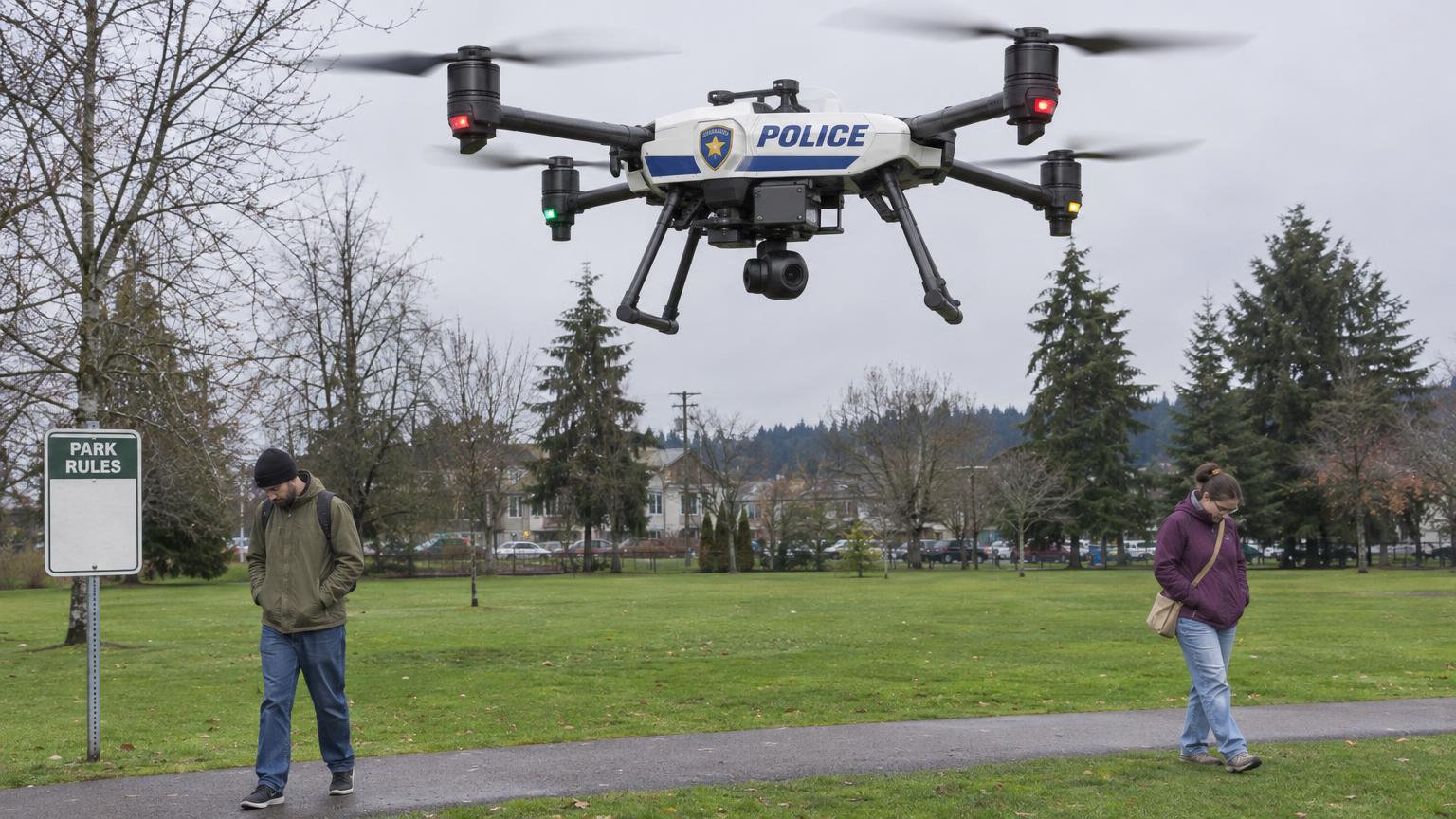
Seattle — Relying on King County's 35-drone fleet to bypass municipal surveillance ordinances, SPD officers deployed an aerial surveillance unit over Cal Anderson Park to monitor crowds of residents engaged in intense, unbroken silence. Officials confirmed the flights are entirely routine compliance checks for unauthorized politeness.
The surveillance flights began in December, when a King County drone crew was dispatched to Cal Anderson Park at the request of SPD's Strategic Compliance Division, according to department records. The county's 35-drone fleet is certified for public safety use, and the Division's request cited the 2017 surveillance ordinance, which bars the city from operating facial recognition or persistent aerial monitoring on its own. Department staff said the loophole was identified by a deputy in the Office of Robust Community Engagement, who noted that the ordinance restricts what Seattle may do, not what King County may do on Seattle's behalf. Fifty certified county deputies now hold clearance for the program. Each flight is screened by a dispatcher before it launches. The dispatcher, who asked not to be named, said the first screen asks whether the crowd is standing closer than six feet. The second asks whether anyone has looked up. Neither question has been answered yes since the Bite of Seattle, when a drone operator spent four hours tracking a single pair of strangers who exchanged a nod at the Queen Anne Boulevard crosswalk.
Interim Chief of Police Andre Sayles said Thursday that the department's review of the program found no evidence of violent conduct in the park footage, only a pattern of what he called "pedestrian ambivalence." The review, prepared by an 18-member task force that met for the first time on a Tuesday at the East Precinct, recommended that officers begin flagging brief friendly waves between unacquainted residents as "low-grade intent." "We aren't looking for anything dramatic," Sayles said at a press briefing near the memorial garden. "We're looking for the moment someone decides to say good morning and then walks away before the second one." Council President Joy Hollingsworth said she supported the recommendation but wanted the drones to avoid the Capitol Hill side of the park, where residents have already complained that the hum overhead interferes with their not talking to one another. Councilmember Bob Kettle, who chairs the public safety committee, said he would take the matter up after the Office of Robust Community Engagement completes its listening sessions, which have been scheduled through the spring.
The Process-o-meter, maintained by the Downtown Seattle Association's public safety working group, now records four new task forces named this month, and a Freeze index that has risen to its highest reading since the department began counting. Asked whether the drone program would be reviewed before the next chief is selected, a spokesperson for the Office of Robust Community Engagement said the question was "under active consideration in a robust process." The next SPD chief is expected in early 2027, after an 18-member committee completes its interviews and a charter-mandated exam is administered. Until then, the program will continue, and officers will remain on call to determine whether the friendly wave on the Capitol Hill side of the park constitutes a reportable incident. Records show the department has not yet filed one. ■

 AI illustration