Poisonal
Pass it along a thing worth keeping

Suspects Arrested in Officer Slaying Promise Full Cooperation via Court-Ordered Zoom

Several suspects arrested in connection with the fatal shooting in Jette have agreed to cooperate with investigators through Belgium's newly established remote interrogation protocol, allowing them to participate in questioning without leaving their cells—or, sources suggest, fully leaving their chairs.

1 month ago • 8 min read

BRUSSELS — Several suspects arrested in connection with the fatal shooting of a police officer in Jette have agreed to cooperate with investigators through Belgium's newly established remote interrogation protocol, the Justice Ministry said Wednesday, allowing detainees to take part in questioning from their cells. The ministry confirmed that the protocol was adopted as permanent procedure last month, eleven days after Parliament moved its budget negotiations to video conference to save €1.3 million in travel and room costs. Cost-saving was the phrase the ministry used in its announcement. Investigators at the Brussels police headquarters on Boulevard Léopold II say the interview rooms on the second floor remain staffed around the clock. They have not been occupied since the protocol took effect. "Every suspect is present in the sense that matters," said an official in the ministry's Directorate for Procedural Continuity, who declined to give a name and whose office could not be located for comment. Cooperation, under the new protocol, is defined as attendance.

JM
Justice Ministry, Directorate for Procedural Continuity
Justice, Delivered Efficiently
:
All Investigating Magistrates and Custody Officers
:
Hélène Vanderborght-Mas, Procedural Continuity Coordinator
:
March 4, 2026
:
Clarification of Cooperation Standards Under the Remote Interrogation Protocol

Following the successful rollout of the remote interrogation protocol, several magistrates have asked how cooperation should be recorded. The following standards apply.

Defining Cooperation:
  • •A suspect is cooperating if he or she is logged into the video session at the scheduled time.
  • •Cooperation does not require the suspect to speak, look at the camera, or remain seated.
  • •A suspect who has muted their microphone is, for the purposes of this protocol, listening.
Connection Interruptions:
  • •Dropped connections will be recorded as technical difficulties, not as evasion.
  • •Suspects who rejoin a session within the same hour may be counted as having never left.
  • •Suspects whose cameras show a blank wall are not to be described as uncooperative in the record.
Terminology:
  • •"Refusal" is replaced with "alternate engagement preference."
  • •"Evasion" is replaced with "distance-based deliberation."
  • •"Silence" is replaced with "audio transparency pending."
  • •The goal of the protocol is to ensure that no interrogation ever reaches a point where anyone has to be in the same room as anyone else.
With continued confidence in our procedural frameworks,
Hélène Vanderborght-Mas, Procedural Continuity Coordinator, Justice Ministry
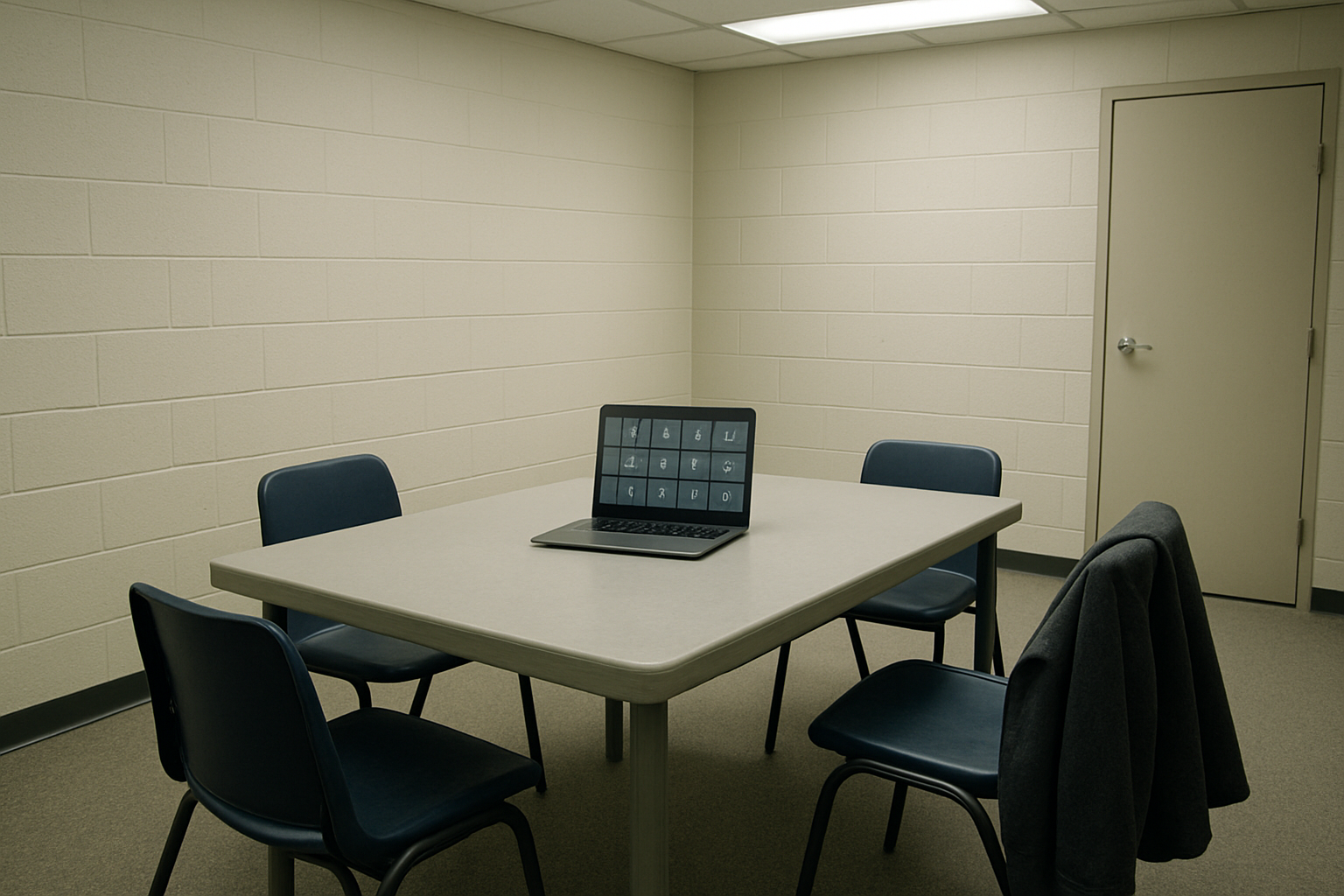
A bare police interview room with a laptop on the table showing a video call grid of muted participants, and no one physically seated.

Interview room, second floor, Brussels police headquarters. Currently in use.

Defense Attorneys Join From Home

Defense attorneys for the arrested suspects have also adopted the protocol. Most now join their clients' sessions from home offices, citing the convenience of not commuting to the courthouse on Avenue de Cortenbergh, a ten-minute drive from their own kitchens. One attorney, reached by phone at a residence in Uccle, said the arrangement had improved his client's privacy. "We can't be in the room with him, and he can't be in the room with us," he said. "It's the most protected he has ever been." The Justice Ministry said that it had increased its IT budget by €212,000 to cover additional Zoom licenses for the custody suites, a figure it described as "a modest investment in continuity." Interrogators have not been asked to attend the sessions in person. The protocol has produced the first criminal interrogation in Belgium in which everyone involved is safer than the suspect.

Excerpt From the First Remote Session
Custody Suite Video Call, Jette Investigation, February 26, 2026
INVESTIGATOR:
[adjusting headset] Can you hear me? The connection is showing a little lag on our end.
SUSPECT:
[seated, camera angled at ceiling] Yes. I can see you. The picture is very clear.
INVESTIGATOR:
Good. Could you tell us where you were on the evening of the shooting?
SUSPECT:
[long pause] I was at home. Or I was in a cafe. The cafe has a camera and the camera is in a different place than the window.
INVESTIGATOR:
Are you saying you were not at home?
SUSPECT:
[camera drifts to wall] I am saying the Zoom is very stable. I am saying I am here now.
INVESTIGATOR:
We've lost your video. Can you turn your camera back on?
SUSPECT:
[microphone muted] The camera is on. The wall is also on.
INVESTIGATOR:
Your audio has also muted. Can you unmute, please?
SUSPECT:
[session ends] Audio transparency pending.
INVESTIGATOR:
[checking clipboard] The session has been logged as a technical difficulty.
Frequently Asked

Remote Interrogation Protocol: Frequently Asked Questions

A suspect is considered present if they are logged into the session. Physical presence is not required by the protocol, and the ministry has not identified any situation in which it would be.
Refusal is recorded as an alternate engagement preference. The suspect remains in the session and is counted as cooperating for the duration of their attendance.
Recordings are stored in the ministry's cloud archive. Investigators have reported that the archive is accessible, although the recordings consist primarily of a grey grid, several muted microphones, and one wall.
Criticism has been received from the Belgian Bar Association, which asked whether an interrogation in which the suspect is not in the room can be considered an interrogation at all. The ministry has thanked the association for its feedback and noted that the question has been logged for future review. The meeting to discuss it has been scheduled on Zoom.
The ministry is considering extending remote procedure to bail hearings, sentencing, and the reading of verdicts, citing the €1.3 million in savings and the protocol's success in keeping everyone in their homes.

Investigators Remain at Their Desks

On the second floor of Brussels police headquarters, the interview rooms are cleaned daily and their lights are kept on. Investigators say they have been asked to remain at their desks and monitor the Zoom grid from their screens. The grid is currently showing seven suspects, four of whom have been muted since the first session. The ministry describes this as a normal distribution of engagement. Asked whether the protocol had produced any results, the Directorate's spokesperson said the protocol had produced a 100 percent attendance rate, which the ministry considers a benchmark for the rest of the European Union. As of this week, no suspect has been asked a question in a room, and no room has been asked to contain one.

More from Belgium