
Pedestrian Safety Campaign Launches With New Emphasis on Accountability; Residents Advised to 'Remain Visible' During Commutes
Following two fatal pedestrian collisions in October, the city launched a 'Visibility and Accountability' campaign urging residents to wear reflective gear and stay alert while crossing streets. The city did not announce changes to traffic enforcement, speed-limit zones, or vehicle regulations—stating that individual vigilance is the most cost-effective intervention available.
The Wilmington Department of Public Safety unveiled its 'Visibility and Accountability' campaign Tuesday morning at City Hall, distributing 12,000 reflective vests to residents in Forty Acres and instructing pedestrians to wear them during commutes. The city made no announcement regarding changes to speed limit enforcement, intersection design, or vehicle traffic regulations. "We can't control drivers," said Marcus Delvalle, the city's newly appointed Director of Pedestrian Compliance and Messaging, during a press conference. "But we can control how visible you are. The onus is on the walker." Two pedestrians were killed in motor vehicle collisions in October—one, a 69-year-old man in an electric wheelchair, struck on Kirkwood Avenue; the other, a 34-year-old woman, hit at the intersection of Third and Market. Neither collision resulted in criminal charges against the drivers.
The city convened its Pedestrian Safety Committee in early November following public outcry over the October fatalities. The committee met for four hours across two sessions, reviewing incident reports, traffic patterns, and crosswalk configurations. Delvalle presented the committee's findings at a closed-door briefing: pedestrians in the collision zones were "not as visible as optimal," according to internal city documents obtained by this publication. The committee's recommendation was unanimous. "Increased visibility is the most cost-effective intervention available," the final report read. The report did not recommend lowering speed limits in residential zones, increasing traffic enforcement, or conducting a vehicle safety audit. When asked why, Delvalle paused for several seconds before responding: "Those are resource-intensive measures."
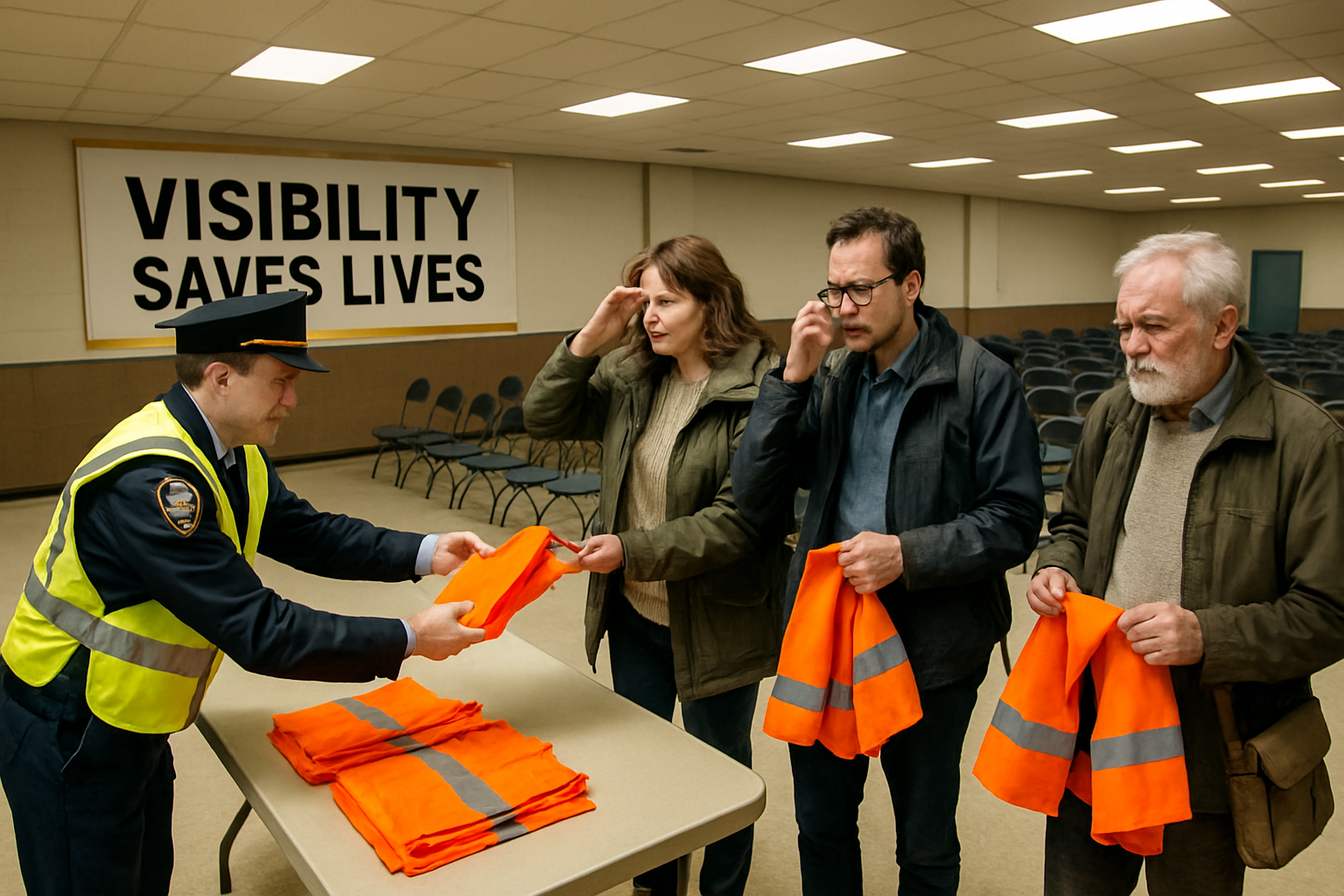
Delvalle distributes campaign materials at kickoff event, Forty Acres community center.
The campaign launched with $47,000 in city funds allocated for design, printing, and distribution of reflective materials. Delvalle announced the vest distribution would begin in Forty Acres, the neighborhood where both October collisions occurred. Forty Acres has the lowest police presence of any city precinct, with the fewest traffic enforcement officers assigned to regular patrol. "We're starting where the need is greatest," Delvalle said. The city did not disclose whether residents in other neighborhoods would receive vests, or when. Separately, the Wilmington Police Department reported that traffic citation revenue increased 23 percent year-over-year, driven primarily by speeding tickets issued in commercial and mixed-use zones. When asked whether increased enforcement would complement the visibility campaign, a department spokeswoman declined to comment on "resource allocation or strategic direction."
The family of the 69-year-old man killed in October was not consulted before the campaign launched. The man had lived in Forty Acres for 31 years and used an electric wheelchair for mobility. His daughter, reached by phone, said she learned of the visibility campaign from a news report. "They didn't ask us anything," she said. "They didn't ask what happened. They just decided he wasn't bright enough." The city's Pedestrian Safety Committee included no family members of the deceased, no representatives from disability advocacy organizations, and no traffic engineers. It included three city officials, one representative from the Chamber of Commerce, and one resident appointed by the mayor's office. The resident declined to be named.
Delvalle said the campaign would be evaluated after six months, with success measured by reported collisions, visibility compliance, and resident awareness surveys. He did not specify what compliance would look like, or how the city would measure it. When asked whether the city had requested speed-reduction studies or reviewed comparative enforcement data from other municipalities, he said the city "prefers to focus on modifiable individual behaviors." He added: "A person can put on a vest. A person cannot control traffic. We have to be realistic about what's in our power." The investigation into both October collisions remains ongoing. Neither driver has been charged.
A traffic enforcement surge would cost an estimated $3.2 million annually, according to a budget memo circulated among city officials in September—two months before the October collisions and four weeks before the Pedestrian Safety Committee was formed. The memo, obtained by this publication, projected staffing and overtime costs for increased speed-limit enforcement in residential zones. The memo was marked not recommended. Delvalle did not respond to a request for comment on whether the pre-collision budget assessment influenced the committee's recommendations. The visibility campaign cost $47,000.